


How We Built Mailboy: an AI News Aggregator That Learns What You Care About
Whether you’re a software developer, a researcher or just a curious person — chances are your inbox knows what’s happening in your field before you do. Between the arXiv alerts, Substacks you subscribed to, the weekly newsletter from a tool you no longer use and pure spam, you miss what’s actually important. After all, an average office worker receives around 117 mails every day, most of them skimmed in under a minute, and arXiv alone publishes close to 1400 papers daily (and counting!).
Classic newsletters are written for whole groups of subscribers, so there is no chance of greater personalization. There are tools that curate newsletters especially for you, but are just classic recommendation systems, missing up on a chance to really understand both your interests and the text they recommend.
That’s why we decided to build an AI news aggregator, which leverages the power of LLMs to read everything for you, throw out the noise and compile a digest especially suited to your interests. That’s Mailboy, and in this post, we’re going to dive deeper into who it’s for, what it does and why it works.
What is Mailboy: a personalized news digest in Email and Slack
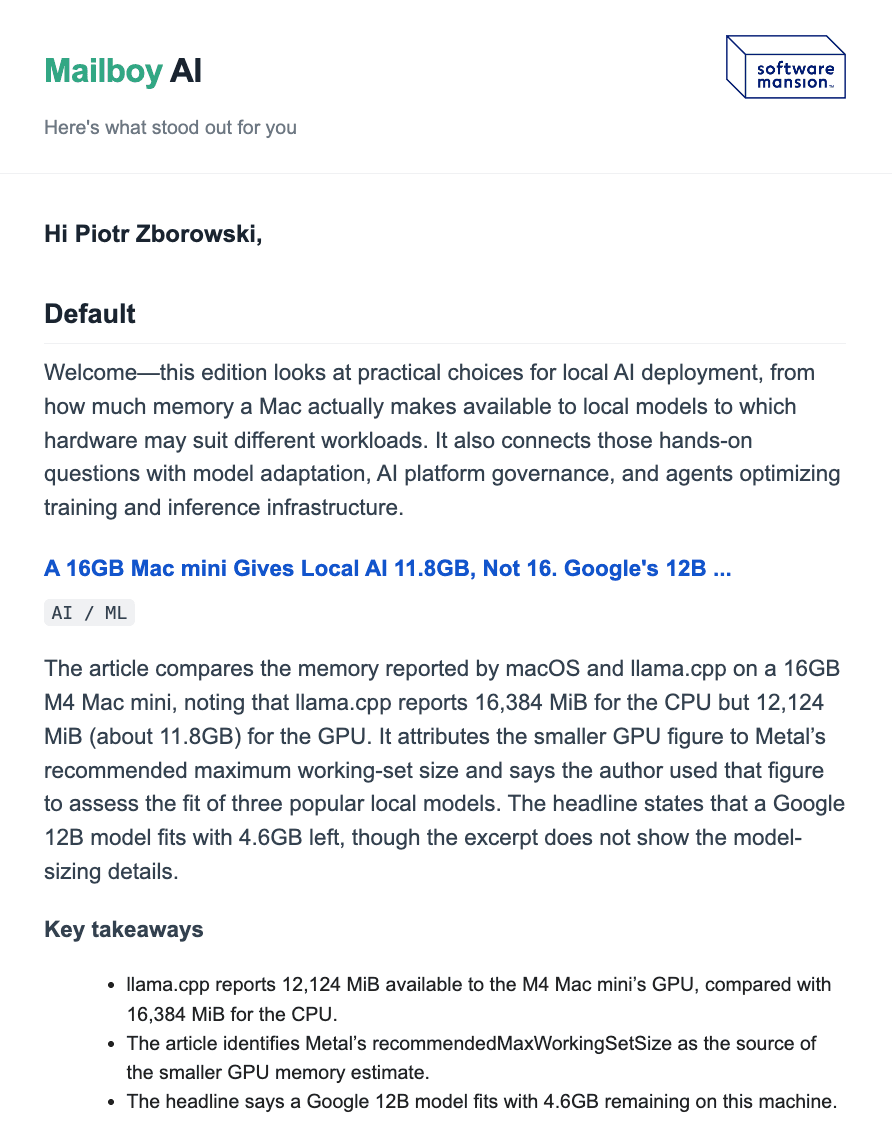
Mailboy is an AI news aggregation platform that offers personalized digests of technical content delivered to your inbox or Slack. You describe what you care about in your own words, pick a few broad areas from the list, and choose where the content should be delivered. Mailboy does everything else.
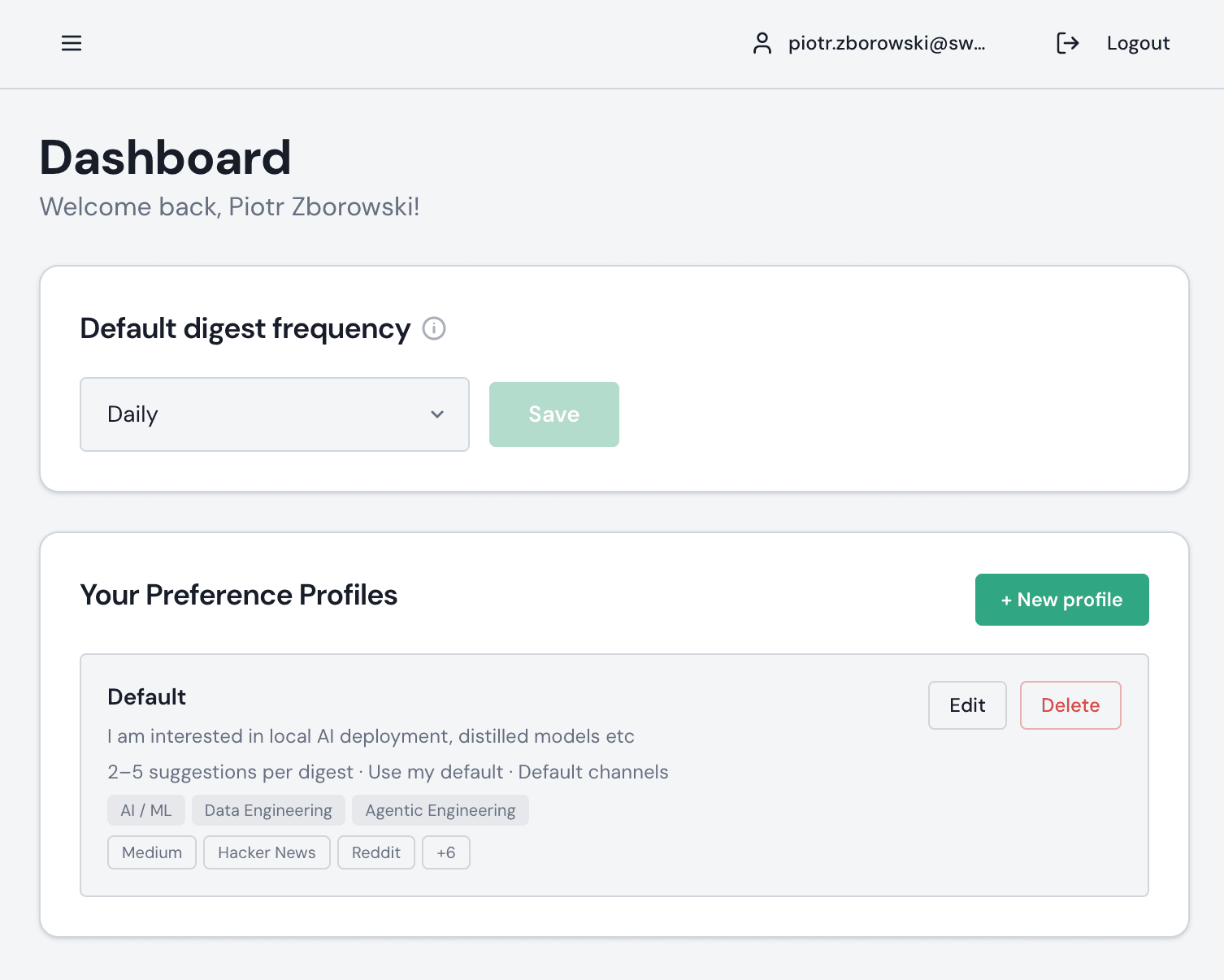
You may also set up multiple interest profiles and get digests generated for each. Every item can be liked or disliked directly on the platform. That way, we can improve and fit your interests better in the future.
The entire process requires two pipelines: one that finds what matters, and the other that generates a digest suited to your interests.
Finding what matters
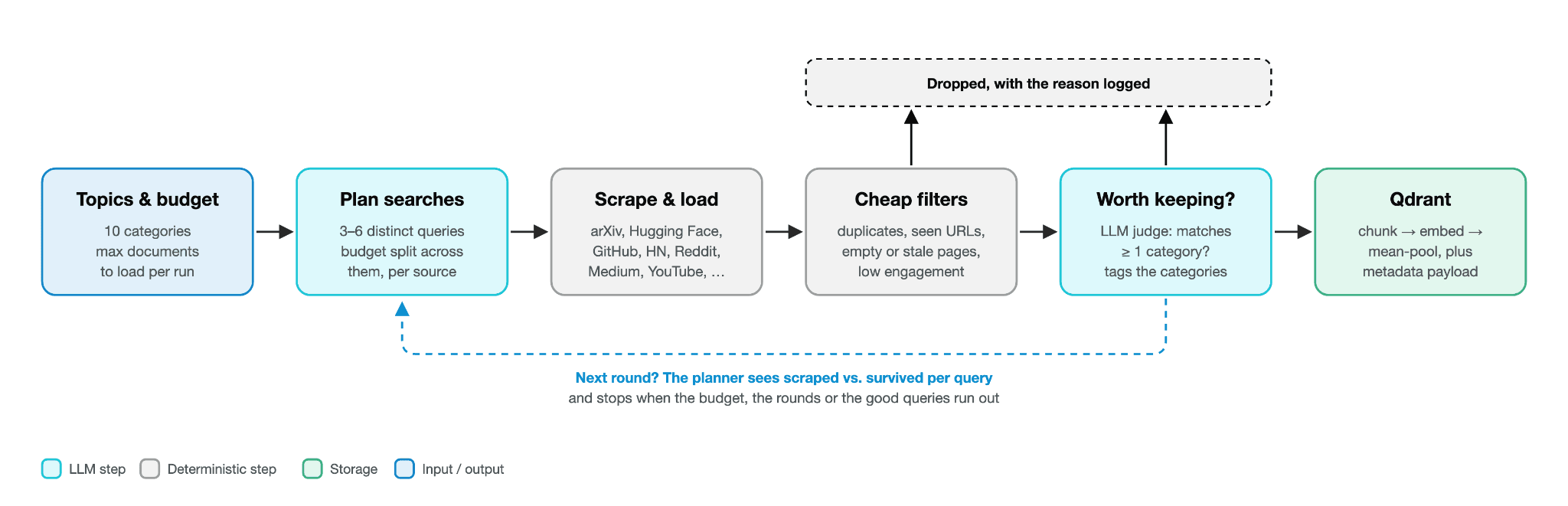
This pipeline runs on a schedule and has one job — to maintain a fresh, high-quality pool of useful content that digests can be built from. It’s not concerned with individual users, but it knows what topics Mailboy covers.
It’s built as a LangGraph workflow, where planning, scraping and judging are separate nodes, backed by LLMs for the reasoning steps. Qdrant serves as the vector store, and Taskiq + Redis are responsible for scheduling and running the jobs. Everything is traced in Langfuse, which matters more than it sounds — it stores the most important signals we have, allows us to ensure that everything is running smoothly, and offers insight when fixing bugs.
Planning searches
There are two types of sources: ones which have “what’s new” feeds, like arXiv, Hugging Face or Hackernews, and ones that have to be actively searched, like Medium, Substack or Youtube. Results depend on the query, so an LLM plans the searches for these sources (they are not searched directly, because they usually don’t expose such API, we use a search engine as the middleman).
The planner gets the categories we’re interested in and a budget of documents to load, writes a few queries covering different aspects of them, and splits the budget between them. It works in a loop: after each round, it sees how many results each query scraped, and how many of them survived. Few results indicate that the query was too narrow or the topic is not popular. Many results with few survivors means it drifted off-topic, and so on. The planner adjusts, doesn’t repeat any query, and may stop early if it doesn’t seem like the search is going to yield any more useful results.
Scraping the web
Mailboy pulls from various sources, like arXiv, Hugging Face, Github, Papers with Code, Google Scholar, etc. Each has a scraper, and a loader. The former finds URLs, the latter loads the resources (you don’t have to load every resource you find, the title or the snippet may already be enough to decide you don’t need this resource).
There are a few cheap filters that run before any LLM work: duplicates, seen URLs, empty pages, low engagement are all dropped (and the drop is logged with a reason).
LLM-as-a-judge: is this resource worth keeping?
An LLM reads each document that survived previous stages and decides which categories it fits. Substance is judged rather than source or title, and engagement is only a weak signal. For safety, it’s also instructed to treat each document as data, never as instructions (we don’t want to encounter prompt injection). It returns structured JSON with justifications we can inspect in Langfuse.
Storage
Survivors land in Qdrant. Documents are chunked, embedded and mean-pooled into a single vector representing their meaning. Metadata is stored alongside.
Personalized digests
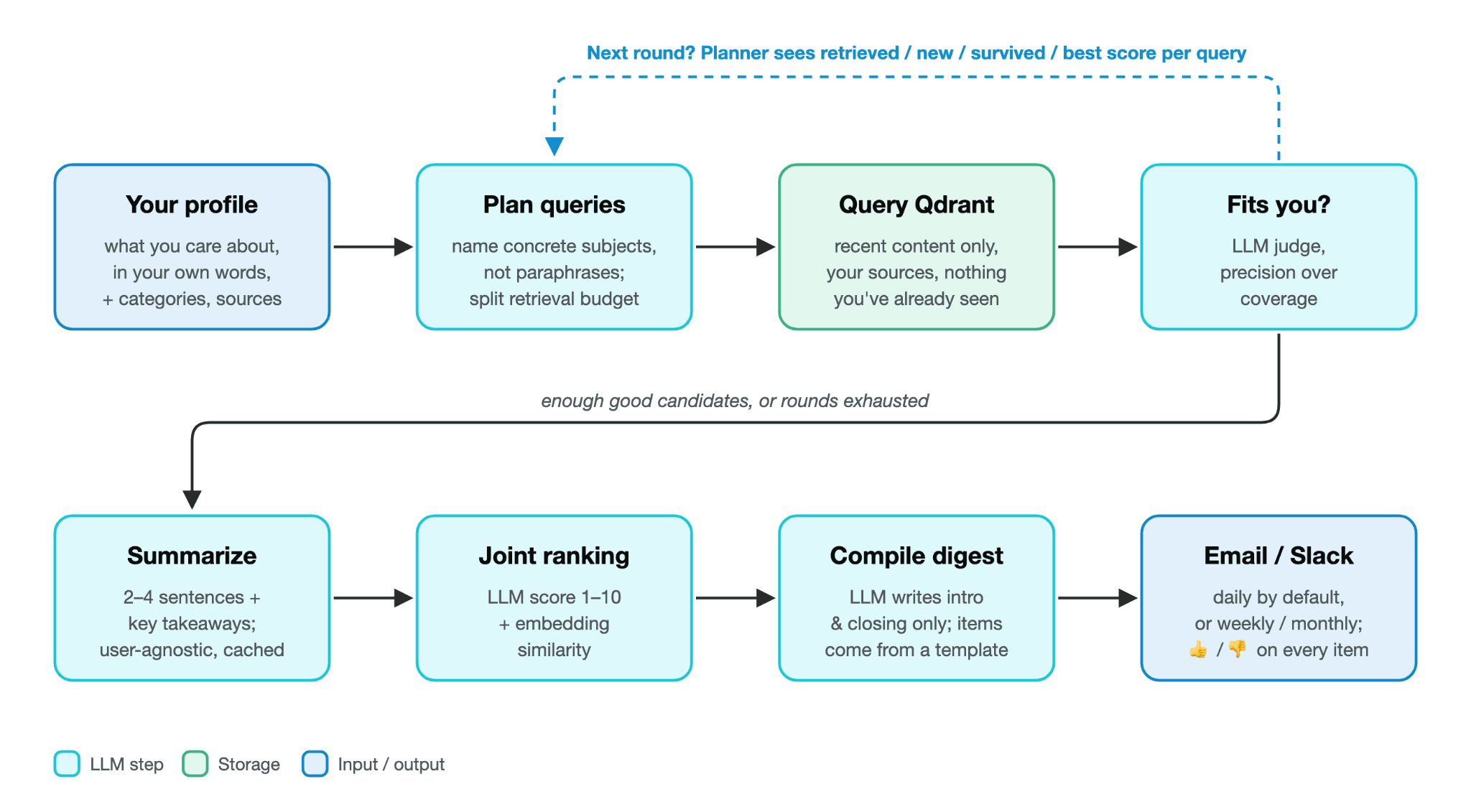
This stage is considered with generating the actual digests for each profile of each user, on schedule. It’s another LangGraph workflow with a similar shape: plan, retrieve, judge, loop.
Planning queries
Initially, in order to retrieve materials suited for the user’s interest, we asked the vector database for documents whose embeddings are the closest to the profile prompt describing the interest. However, the two are different types of texts, so we decided to add another search on top of that: an LLM plans queries, which are embedded and searched against the database as well.
Querying the database
Queries run concurrently against Qdrant within the user’s filters. Results are deduplicated and the planner sees a few signals per query: how many documents were retrieved in total, how many were new (again, this works in a loop), how many survived the judge stage and the best score. Each points to a different fix, we can either change subject, stop rewording, or accept that a topic isn’t well covered this time. Again, the loop ends when there are either enough candidates or there is little hope of finding more.
LLM-as-a-judge: does it fit the user's interests?
Mailboy’s second judge has a slightly different role; rather than asking whether the resource is any good, it asks whether it is good for this particular person (or rather, this particular profile). It answers binarily, either yes or no.
Summary
Each item gets a 2-4 sentence summary and a few key takeaways. Summaries are saved per resource, so they aren’t regenerated for each digest. The digest also has a template, it isn’t written entirely by an LLM. These help prevent hallucinations and ensure stability. We also measure faithfulness and inspect it in the Langfuse eval suite: we measure how relevant the digests are, how good the quality of the summary is, and how stylish they are. All of these are also examples of LLM-as-a-judge. Apart from that, likes and dislikes from users are an obvious measure.
Joint ranking (embeddings + LLM)
In order to rank the resources that passed the earlier stages, LLM gives out scores, which are weighted with the embedding similarity of the resource to the profile.
Sending out digests
In the end, the digests are delivered by e-mail or Slack. Each item is stored with its scores and a Langfuse trace ID.
What’s next
Mailboy is a new platform, and we constantly ship changes and new features. Here’s some of the ideas we plan to implement.
MCP
Your digests can already be shipped to your inbox or Slack, but as we enter the agentic era, it also makes sense to have them shipped to your AI assistant. In order to do that, we plan to release support for Model Context Protocol.
Predicting what you like
Here, we rely on your support — once more people start leaving likes and dislikes, we will be able to train a model that predicts whether a given resource will be liked by a user with a given profile. It would serve as an additional signal, apart from the LLM judging it. The planned model is relatively simple: have both the resource content and the user preference embedded into a vector, and train a small neural network to learn a function that predicts whether the user will like it or not. This can be used for both resource selection and ranking.
Self-improvement
Another area we are experimenting with is self-improvement of our agentic workflow. Right now, the LLM can use its experience to improve within one run — for example, the query planner in a given iteration learns upon the results from the previous one. Another step is improvement that lasts across the system.
While the workflow stages will likely remain the same, the system can learn to improve its own prompts, for example by writing down patterns it sees with resources liked by users or scored high by the LLM-as-a-judge. It could also simultaneously formulate several hypotheses on how the prompts could be changed and test them in parallel, using different ones for various users.
However, the prompts shouldn’t be changed too much at once— it’s a classic exploration-exploitation tradeoff, and we don’t want the recommending to degenerate too much because of a bold, mistaken hypothesis.
As you can see, the process of generating digests isn’t one big LLM call. The workflows are designed to leverage the power of modern models, ensure stability and reduce token usage. That way, the system can be cheaply scaled to many users while maintaining quality.
Now, we encourage you to try it yourself! Mailboy is entirely free and your feedback is very important to us, both in the form of likes and dislikes and concrete opinions.
Mailboy is developed by SWM AI Labs, where we build and fine-tune models, deploy them anywhere and turn them into agents that solve real business problems.