Modernizing Real-Time Infrastructure and Improving Observability for Supabase
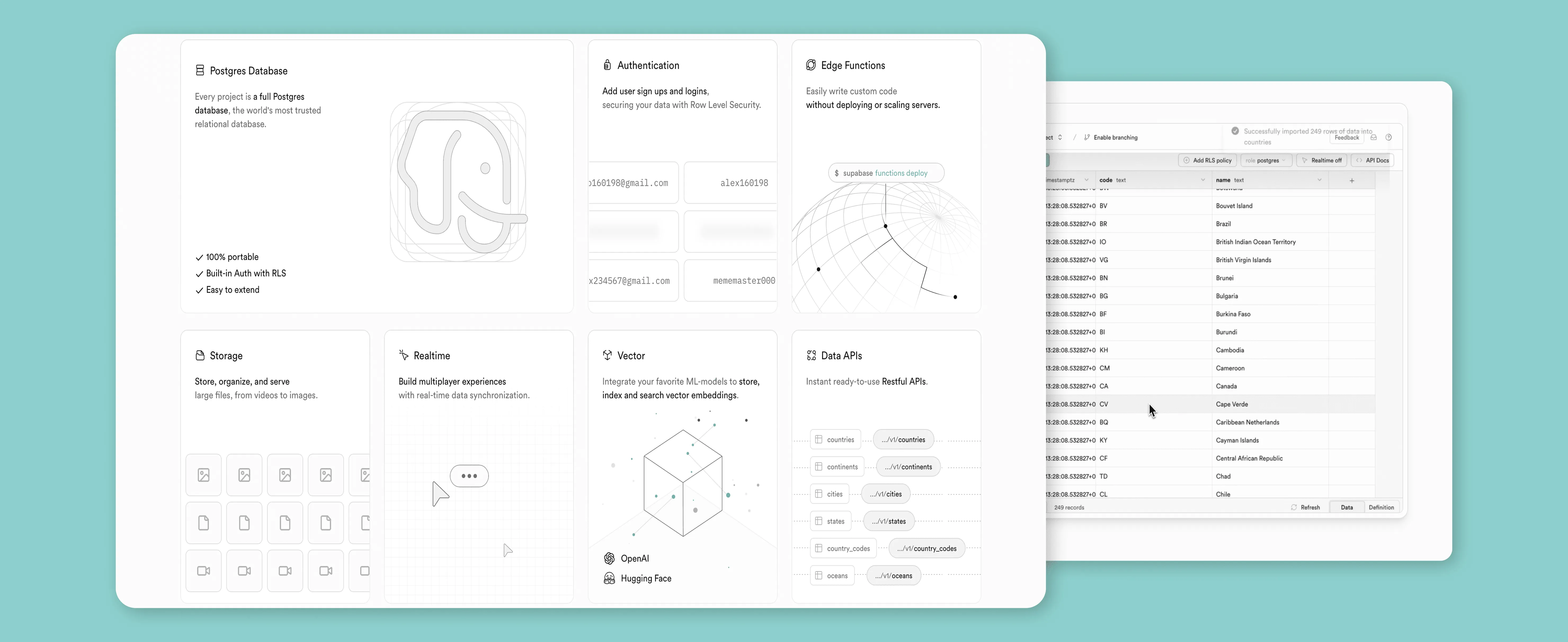
Supabase is an open-source platform built on Postgres that provides developers with authentication, instant APIs, edge functions, real-time subscriptions, and more.
We collaborated with the Supabase team to support two parallel efforts: modernizing the Realtime.js SDK to use the Phoenix.js implementation and delivering performance and reliability improvements to Logflare – an observability tool used for processing logs and metrics at scale.
- Consulting
- SDK modernization
- React Native integration
- Elixir backend development
- Testing infrastructure development
- Architecture development
- Open-source contributions
- AI engineering
- TypeScript
- JavaScript
- React
- Elixir
- React Native
- Phoenix
- Vitest
Challenges & goals
Supabase approached us with a goal to improve the reliability and maintainability of their Realtime.js solution while ensuring it remains easy to use across different environments.
Alongside, the Logflare system required a few improvements in performance and scalability, especially around log ingestion and processing.
Together, we worked on:
- Rewriting Realtime.js to Phoenix using AI
- Reducing the need to maintain custom forks of underlying libraries
- Ensuring the SDK works reliably across web and mobile environments
- Developing testing strategies for a library-based ecosystem
- Optimizing key parts of the logging pipeline
Throughout the process, we collaborated through pull requests reviewed by the Supabase team. That meant quality had to be high from the start, with no room for cutting corners and fixing things later in private.
Realtime.js: modernization and the Phoenix implementation
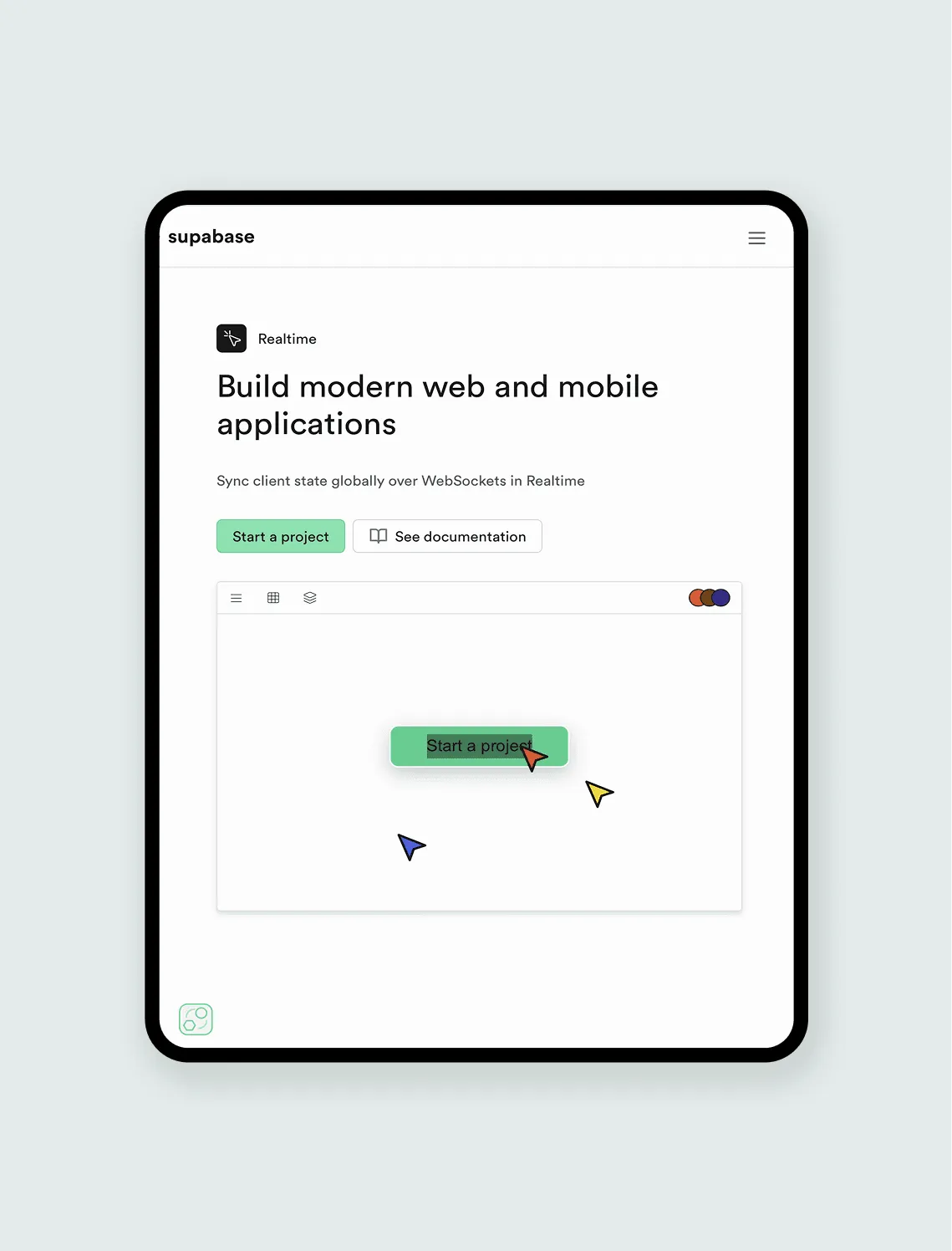
Realtime.js is the part of the Supabase SDK that handles real-time functionality: broadcasting messages to channels, subscribing to database changes, tracking presence to know which users are currently active, and many more.
Under the hood, it uses WebSockets via Phoenix.js. Over time, Supabase had developed a fork of Phoenix.js that diverged considerably from the upstream library. Maintaining that fork had become challenging, and the team wanted to move to using the canonical Phoenix.js implementation directly. But before committing to a full migration, they needed to know whether it was even possible – and that's where we came in.
Building the proof of concept
We started with a PoC. The client trusted us to make the right technical calls and check in with updates. That trust set the tone for our whole collaboration.
One of the first things that became clear was that Phoenix lacks proper type definitions. The library used JSDoc comments – and some of those comments referenced types that didn't exist, or described functions vaguely. We worked through them carefully, using AI to write correct type definitions and keeping the changes as minimal as possible so that integrating future Phoenix.js updates would be straightforward.
After roughly one and a half months, the PoC – covering all key functionalities – confirmed that the migration was viable, and the client asked us to proceed with the implementation, focusing on improving code quality, fixing types, updating unit tests, and ensuring the API looks the same.
Working on the full implementation
The central benefit of moving to Phoenix.js was a shift in responsibility: the WebSocket connection layer now belongs to the Phoenix.js project. This means that instead of owning a diverging fork, Realtime.js became a wrapper: cleaner, lighter, and easier to keep current going forward.
The main constraint we worked within was that this change couldn't be visible to developers using the SDK. The API had to look and behave the same. To achieve that, we built an abstraction layer over Phoenix.js, aligning function names and call signatures where possible so that existing code would continue to work without modification.
During this process, we discovered a subscription issue. It was an edge case where trying to subscribe to a channel more than once would be silently blocked, due to how Phoenix.js manages channel state. We identified the cause, advised the client on the right fix, and added a helper function that correctly handles callback transfer and channel recreation. We also made a handful of smaller contributions upstream to Phoenix.js itself during the course of the work.
Finding the right approach to testing without direct platform access
Testing a client tool when you can't run the full platform behind it requires a different approach. Since Supabase is open source and we were building a library, the only real way to verify our work was to build applications that actually use it.
The client gave us the freedom to treat this like a hackathon: we were allowed to build something real, see what works, and learn from that.
So, we built a shared terminal demo and an interactive Realtime explorer: a browser app where you can configure connections, set up channel bindings, and observe messages flowing in real time.
These apps were the foundation for a mini test suite, with automated tests running against the actual library in the browser, giving the Supabase team a practical way to verify Realtime behavior.
React Native integration
The client wanted to make Realtime work reliably in React Native. We knew there were cases when a mobile app goes into the background and the WebSocket connection drops, and restoring it cleanly when the app comes back to the foreground wasn’t handled well in the previous implementation.
That’s why we decided to extend the test playground to run as an Expo mobile application, reproduced and confirmed the reconnection behavior, and built a set of React Native hooks that tie Realtime channel connections to the mobile app lifecycle. With these hooks, connections are managed automatically depending on whether the app is active or backgrounded, closing a gap that had caused problems for React Native developers using Supabase Realtime.
We also published an open-source scaffold repository demonstrating how to approach Realtime integration in React Native, which can serve as a starting point or reference for the community.

Logflare: performance and reliability improvements
Logflare is a log and metrics platform integrated into the client’s infrastructure. When running a self-hosted Supabase instance, Logflare handles log collection and routing across the stack. Overall, it's a big, distributed Elixir application built to process significant data volumes.
We also joined the Logflare team as external contributors, bringing our Elixir expertise to collaborate on improving several areas of the platform.
Integrating the BigQuery
The platform was sending data to Google BigQuery using a legacy REST API that has since been deprecated. We migrated this to Google's newer Streaming API over gRPC.
The new approach supports modern data formats and produces more compact log payloads, which means less outbound traffic on every event. And on a platform handling Logflare's volumes, that reduction translates directly into lower costs on Google Cloud, and it's also faster.
Working on the ingestion pipeline's rule evaluation logic
Logflare's ingestion API is where incoming log events are received and routed. Each event is evaluated against a set of user-configured rules to determine where it goes. Those rules can match on values and apply various conditions. With the original implementation, every rule for a given source was checked against every event, one by one.
We rebuilt this as a tree-based data structure: rather than walking the entire rule list for every event, the system now traverses the tree and prunes branches that can't apply early in the process. Only the rules that are actually relevant to a given event get evaluated. This brings evaluation closer to logarithmic complexity, meaning the system checks far fewer rules per event compared to a sequential scan.
Working on Adapters to enable data export from Logflare
We implemented a set of adapters that allow exporting logs from Logflare to external observability services. This included integrations with Axiom and Last9, as well as an adapter for OTLP (OpenTelemetry Protocol), which serves as a universal standard for telemetry data exchange.
Delivering this required refactoring parts of the existing adapter system to make it more consistent and extensible, ensuring new destinations could be added without increasing system complexity. These changes also laid the groundwork for the Supabase’s new Log Drains destinations, which route logs from the Supabase stack to third-party services.
More recently, we extended the adapters with connection testing capabilities, allowing users to validate external integrations before enabling log streaming.
You don't have to trust our words. See what our clients say:
“Working with Software Mansion has been a pleasure, as Bartosz, the attached engineer to the Observability Team, has been able to handle any tough technical challenges that we’ve thrown at him, even with ambiguous scopes and tricky performance issues. Being adaptable to Supabase’s async working style has also earned the team high marks in our book, and we look forward to overcoming more interesting problems together.”

“Software Mansion did an outstanding job on Supabase Realtime. They handled a complex migration of realtime-js to the Phoenix JS library, built a full E2E testing framework, and fixed React Native reconnection issues — all without disrupting existing users. That’s no small feat for a package with nearly 20 million weekly downloads. Dominik, Alan, and Michał were a pleasure to work with: communicative, thorough, and always coming with solutions. We’d love to work with them again.”

Results
Working on this project was truly rewarding as we had the freedom to share our expertise and suggest solutions that are best suited to the goals and needs of Supabase.
That kind of relationship produces the best results: when a client trusts you as an expert rather than just a task executor, you can address problems at their root instead of relying on workarounds. Some of the project highlights include:
- Realtime.js successfully migrated to canonical Phoenix.js, eliminating the need to maintain a custom fork
- Browser-based test playground built from scratch
- BigQuery integration modernized, reducing traffic costs and adopting current API standards
- Logflare ingestion pipeline optimized with a tree-based rules engine
- Cache reliability improved across Logflare's configuration layer