
Demuxed 2025 — Recap by Software Mansion
 Łukasz Kita•Nov 12, 2025•5 min read
2 weeks ago, my colleagues and I attended the Demuxed 2025 conference in London, UK. It was a great opportunity to meet fellow video devs and share experience gained in the field of multimedia.
As a conference sponsor, Software Mansion had the opportunity to showcase a demo of our in-house built dev products. We set up a TV and invited everyone to play Pufferfish — a unique real-time competitive game developed with Smelter, Fishjam and TypeGPU. Unlike traditional games built with game engines, Pufferfish’s entire playground is composed as a video and streamed to all players. Our goal was to show that using the right technology, you can achieve latency so low that playing the game feels completely lag-free. This worked out great — the gameplay couldn’t be more fun, with over 100 unique players throughout the conference, many of whom were coming back to our stand.
Out of the many impressive presentations at the conference, I chose a few that felt particularly meaningful to me because they closely matched my interests. I’d love to share more about them!
1. “Why I ditched cloud transcoding and set up a mac mini render farm” by Sam Bhattacharyya
In his talk, Sam explained that transferring data between the GPU and CPU can eat up as much as 60% of total processing time in GPU-heavy tasks like upscaling or running AI on video frames.
At the same time he proposed a cure for it which is applicable at least in small and medium scale applications — namely “Unified Memory”, allowing for storing data in places accessible by both CPU and GPU, which completely removes the need to transfer data.
I was really impressed to see how Apple’s new M4 chips, with their shared memory design and built-in hardware for encoding and decoding, can hold their own against high-end Nvidia GPUs — all while costing much less!
2. “A default HLS player for Chrome (and why I hate the robustness principle)” by Ted Meyer
Ted’s talk focused on building a native HLS player as part of the Chromium project — a massive undertaking when your work is going to run on billions of devices! That kind of scale brings both excitement and responsibility — along with a lot of careful planning.
A main challenge in developing the player is being on the “accept” side of the robustness principle, which involves accepting a wide range of streams even when they deviate from the strict standards. In reality, many stream producers do not fully comply with the HLS specification — for example, it’s estimated that about 40% of all HLS playlists on the internet omit the required comma at the end of the EXTINF tag. Ted shared several more examples where strict compliance had to give way to real-world flexibility, and there’s even a full list of these quirks available for the Chromium HLS player.
The first version of the native player shipped with Chrome v141, but a bug was soon discovered — it’s already been fixed and will roll out in Chrome v142.
If you’re curious to see how it performs on your own device, you can try out Ted’s conformance testing tool on his website.
3. “Reconstructing 3D from Compressed Video: An AV1-Based SfM Pipeline” by Julien Zouein
Structure from Motion (SfM) — turning 2D recordings into 3D models — might sound complicated, but Julien showed how familiar video encoding techniques can make it surprisingly approachable!
Together with his team, he detailed their research in the paper “Leveraging AV1 Motion Vectors for Fast and Dense Feature Matching”. Their approach used the centers of macroblocks and motion vectors from AV1 encoding to track points, filtering out tracks where the motion vectors weren’t parallel. This meant they could work directly with encoded video frames — no full decoding needed — while taking advantage of the optimizations already built into video motion vector detection. Their method achieved results that matched or even surpassed the standard COLMAP pipeline using SIFT features — all while using just 5% of the computational resources.
4. “MoQ: Not Another Tech Demo” by Luke Curley
Luke wanted to go beyond just proving that media could be streamed using Quick — so he built hang.live, a videoconferencing app that leverages MoQ’s features, on top of his Media Over Quick library. He even drafted what looks like a preliminary RFC for the custom protocol his app uses!
During the talk, he highlighted one of MoQ’s most useful features — the ability to add any custom tracks alongside media tracks, as long as the sender and receiver agree on the format. This removes the need for a separate side channel to transmit extra data. MoQ also optimizes resource usage automatically — data is only sent if there’s demand, which sometimes means the broadcaster doesn’t even need to start the encoder.
Luke went on to show how MoQ’s standardized publish-subscribe model and built-in discovery mechanism simplify videoconferencing architectures. He stressed that the biggest advantage of MoQ is its high degree of customizability — but he also cautioned that for certain use cases, especially VOD, established solutions are still a better choice.
Other presentations were equally impressive, and I’m looking forward to seeing them shared publicly soon!
But that’s not all!
I was also fortunate to be selected for a three-minute lightning talk to share my recent research on automatic parsing of the H.264 specification. Stay tuned — I’ll be publishing a more detailed article on this topic soon, where I’ll dive into the techniques, challenges, and potential applications.
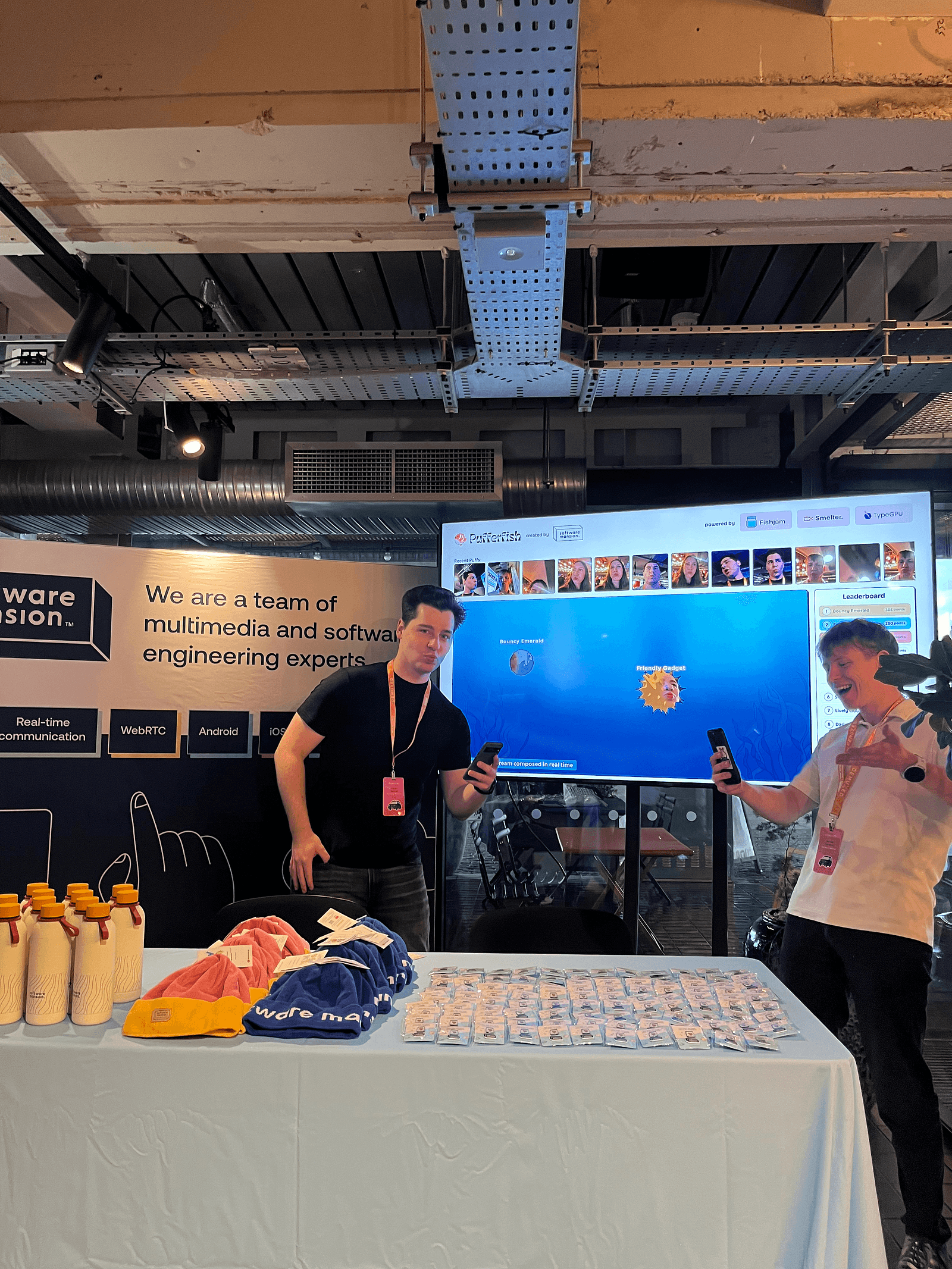
Thank you, Demuxed
Attending Demuxed 2025 was extremely valuable — from connecting with fellow video developers to exploring cutting-edge ideas in multimedia. I’m already looking forward to the next edition of the conference, which will return to its San Francisco roots.
And if SF feels a bit too far, be sure to check out RTC.ON — a conference for audio and video developers organized in Kraków, Poland, by Software Mansion. We’re already planning the 2026 edition, so sign up for our newsletter to stay updated and not miss any announcements!
We’re Software Mansion: multimedia experts, AI explorers, React Native core contributors, community builders, and software development consultants.